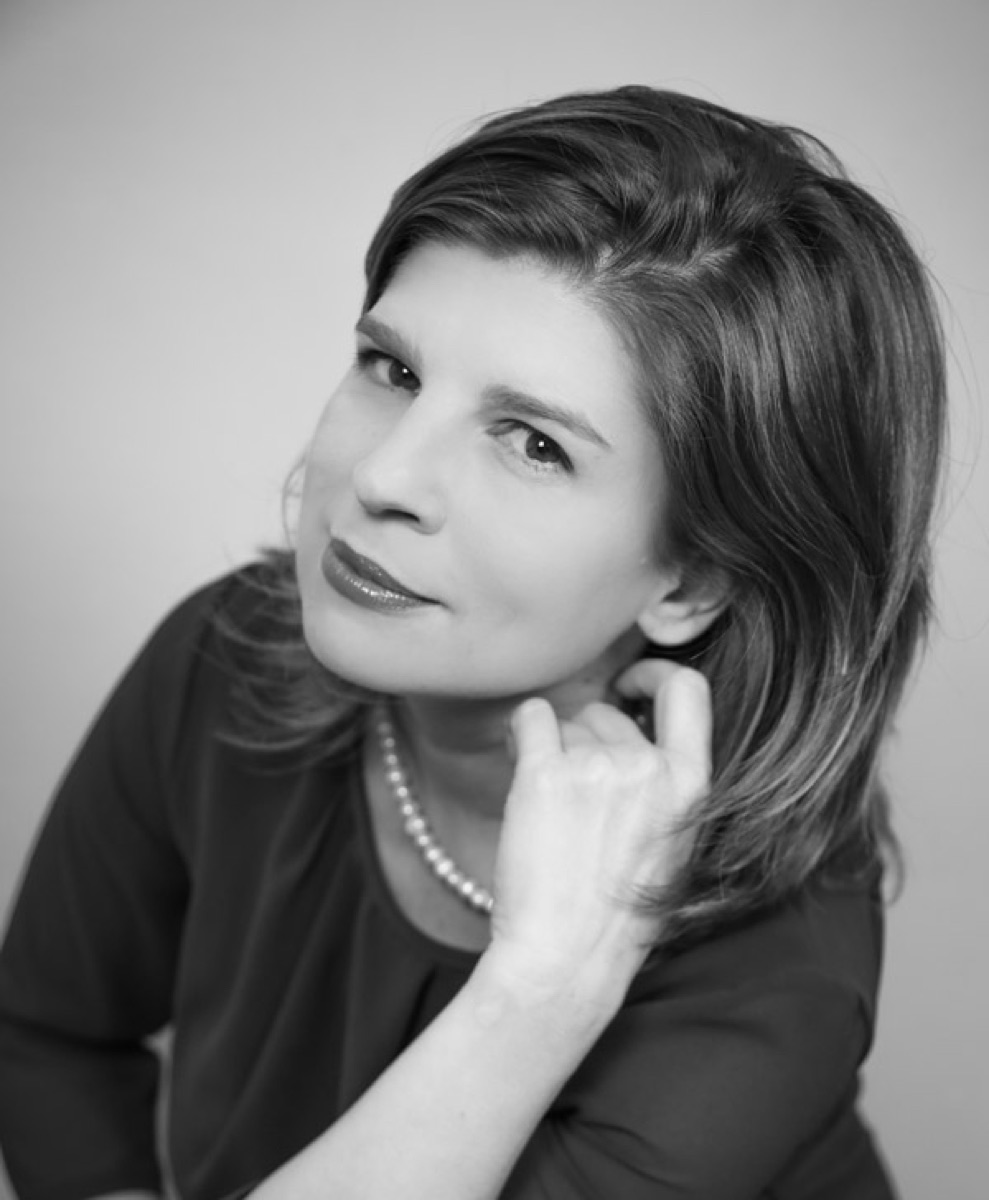
Olga Bolgari studied opera and operetta at the Vienna Conservatory, musicology at the University of Vienna, and vocal education at the University of Music Vienna. She comes from Moldova, where she studied choral conducting, singing, piano, and musicology.
Mrs. Bolgari was awarded a special prize at the „Ferruccio Tagliavini“ Competition and received the Mentor’s Prize at the „Heinrich Strecker Operetta Competition“.
Since 1997 she has worked internationally as a concert and opera singer. Mrs. Bolgari performed Oratorios, Concert Arias, German (as well as Viennese) Lieder and baroque Programmes with various ensembles in Italy, Argentina, Mexico, USA, France, Portugal, Cyprus, Germany, Latvia and Austria. She was engaged at the „Neue Oper Wien“ and staged the Queen of the Night (Die Zauberflöte), Arsena (The Gypsy Baron), Fire and Nightingale (L’Enfant et les Sortilèges). Olga Bolgari interpreted the Soprano-Solo in Brahms „German Requiem“ touring Portugal, and the Soprano-Solo of Gustav Mahler´s 4. Symphony in Mexico. She sang „Four Last Songs“ by Richard Strauss at Kairo State Opera and performed Mozart’s „Requiem“ and Haydn’s „The Seasons“ in Paris.
From 2009 to 2011 she was an ensemble member at the Municipal Theatre of Baden. She sang in the opera “Hoffmann’s Erzählungen”, musicals such as “Les Misérables” and “Annie Get Your Gun”, and operettas such as “Wiener Blut”, “Maske in Blau”, and “Zigeunerbaron”. From 2012 to 2017 she taught classical and musical theatre students at the Vienna Conservatory while actively developing her holistic voice system.
In 2017 she began teaching at Jam Music Lab Private University Vienna. In 2020 she moved to Linz, where she became choir conductor of the children’s choir at the State Theatre of Linz, Upper Austria. In 2022 she moved to her next role as a singing teacher and choir conductor at the state music schools of Upper Austria (Landesmusikschulwerk Oberösterreich), where she still works. Since 2025 she has been part of Chorverband Oberösterreich as a member of the Landeschorleitung team.
Modern vocal technique and singing interpretation with Olga Bolgari, soprano and vocal coach
Contents of the masterclasses for professional singers or students:
– Training voice-technique and body-work for singers in all music styles – Tuition with focus on determined issues: voice projection – Fine tuning and finding right vibrato – Supporting: best exercises, based on your own nature – Dynamics, Arpeggios – Diction in German, English, French, Italian and Russian – Musicality, phrasing and Interpretation; Special: Viennese Music
Content of the voice workshop for people who want to develop their voice: THREE-DIMENSIONAL VOICE UNFOLDING by Olga Bolgari
Like many other things in our life the human voice connects various contrasting factors. There is, for example, warmth and volume but also precision and sharpness. Another factor is the high and deep register of our voice. Through a homogeneous voice sound we can bring together these two distant areas. So that at its best they sound as if they were on the same level.
The third factor is, for example, breathing out. While singing we keep the posture of breathing in. Otherwise we would lose our supporting and the high position of the voice. As you all know, we not only sing with our voice lips, but with our whole body. The whole body is our instrument. In order to extend our limits, we have to stretch and strengthen our muscles through special movements during the phonation.
In our body everything is ready for perfect singing, but we are not always aware of it. The functions of our voice go through all the dimensions of our soul and body. Let’s look at one after the other.
In the first dimension we deal with the vertical pillar which means our connections with the earth and the sky. For your voice this means strength through support of your abdominal muscles and brilliance through the use of the resonating cavities of your head. The first exercise is: watch, what you feel, when pronouncing the fricatives like, ffff, sssss, shshshsh… What happens with your abdominal muscles? Can you feel the tension moving downwards? Through these fricatives we learn how to let our breath flow continuously and evenly, also in long phrases. The better your supporting technique works, the bigger your voice range will get.
You will also be able to sing with a higher formant because good supporting helps to open the resonating cavities in your head. Additionally we can achieve more brilliance through special movements. To extend your vertical pillar towards the earth please crouch down and feel your pelvic floor opening while breathing in. With this exercise we activate the growth of our roots. The interesting moment begins while singing: the roots grow with every tone. Please try it first with our best friend, the fricatives! Shshshshshs… ffffff, wwwwww….
With the work on the Second Dimension we open up our inner spaces. This field has reciprocal effects on the confidence in ourselves, in others, in God and in life. With the next exercises we will open up the areas of the abdomen, the lungs and the ribs, and also the throat. The throat stays open automatically, when we work vigorously with our body.
At the beginning please put your hands below your navel. Just feel what is happening, don’t interfere with your breathing. Observe where you are with your breathing. I hope you can feel that by becoming aware of your breathing, it will begin to change. With this kind of attentiveness you will notice that your breathing is flowing more freely, and is getting calmer and deeper.
Second exercise: turn the upper part of your body as much as possible and concentrate on your inner space. Breathe in. With this asana from yoga you can feel your solar plexus very well. Turn back and let go. Now, the same exercise on the other side. With the next example you will feel how big the space in our lungs can get. Please, breathe in 3 times without breathing out in between. Hold your breath as long as possible, this will strengthen your muscles. Then let go and breathe out.
All these exercises can show you the opening of your inner spaces while breathing in. But we need these spaces when singing. Singing is our active phase, and breathing in is our passive one. This means that our inner spaces will open up passively and expand just like after pronouncing explosives. Observe your reflexes when pronouncing fricatives in combination with explosives: ffffft, ssssssp … Try to achieve the same feeling with vowels as with fricatives. Take alternatively for example “a” and “sh”. Transfer the feeling of “sh” to “a”. This is the most important breathing technique of singing: try it with your songs.
The Third Dimension concerns the capability of communicating while singing. We achieve directness and a powerful drive of the voice by making use of the flexibility of the spinal column to turn. For example an exercise to train this: take a silk scarf and try to throw it as far as possible by starting from behind you. The second exercise combines the turning capability of the body and the flowing of the voice. Start with a slight step position for a better balance. Then make a rotating movement with your arm starting from down below and moving up alongside your body. Let’s sing for example “A” and imagine your voice flowing with your arm and through your eyes towards the audience.
You can combine various dimensions in your exercises and practice your musical work at the same time. The aim is that the exterior movements will be memorized by your body. You will become able to feel the inner flow of these movements while singing even though you stand still. The body will store the adequate inner movements in the subconsciousness and will apply them in a free style way, depending on the musical challenges.